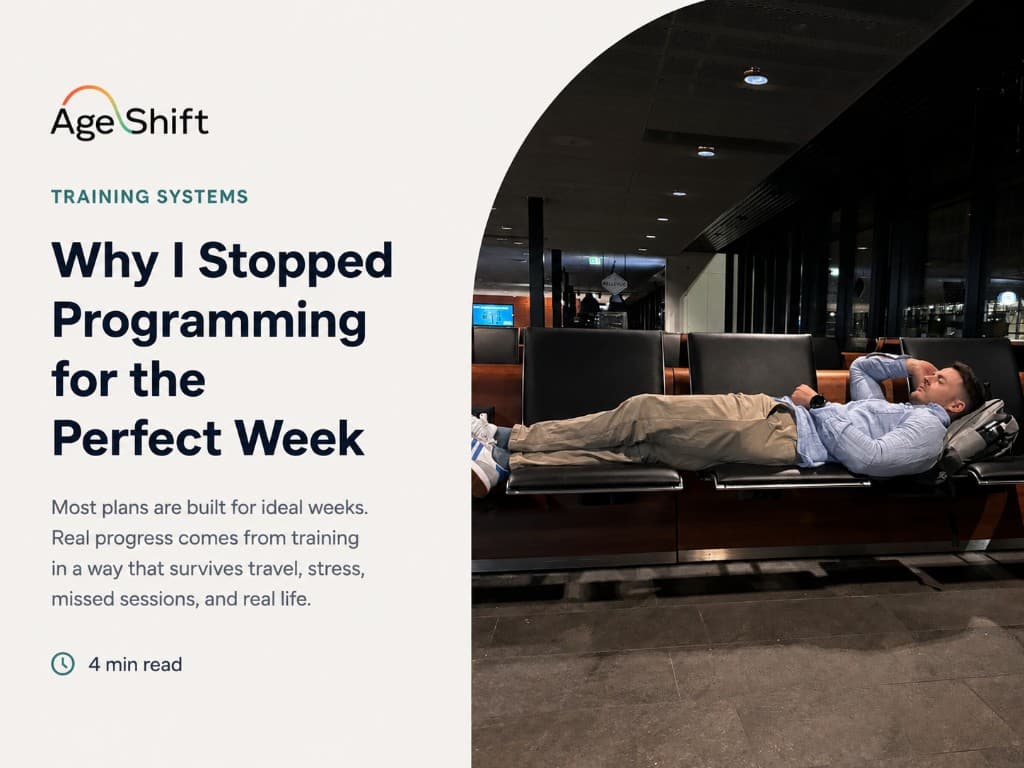
Why I Stopped Programming for the Perfect Week
Most plans are built for ideal weeks. Real progress comes from training in a way that survives travel, stress, missed sessions, and real life.

Heinrich Tessendorf
6 min read
I missed a flight in Zurich once, sprinting maybe 500 meters through the terminal in a pair of cheap entry-level sneakers with a roller bag clattering behind me. I got to the gate. The door was closed. They rebooked me through Amsterdam, where I landed with another tight layover and ran another 700 meters at something close to race pace to make a connection I actually caught.
It took my Achilles a week to forgive me. Not my legs — my legs were fine. The tendons. I wasn't doing much running at the time, partly because I'd been telling myself I was "focused on other things," and the cost of that decision arrived at Schiphol, courtesy of a gate change and a tight rebooking.
Every plan I've ever followed had the same flaw. The flaw isn't the exercises. It's the assumption.
Design load vs peak load
There's a useful distinction in engineering between design load and peak load. You design a bridge for the trucks that will cross it on a Tuesday. You also design it for the once-a-decade storm. If you only build for Tuesday, the bridge is fine until it isn't.
Most training plans optimize for design load. The week you've imagined. The mood you'll be in. The recovery you'll have. The sleep, the food, the headspace. That's the workout that "fits the plan."
But the things that actually break people aren't the design-load weeks. They're the peak loads — the sprint to the gate, the bag you carry up four flights because the elevator is out, the impromptu hike you didn't taper for, the slip on ice in February. These don't show up in a 12-week block. They show up in life.
If your training only prepares you for the planned stimulus, you're brittle against the unplanned one. My Achilles weren't injured because I sprinted. They were injured because I had stopped giving them any reason to expect that I might.
So I stopped writing the perfect week
What I do now is closer to a portfolio than a plan. There's a small set of things I want to maintain — the boring foundational stuff that makes me robust against whatever Tuesday throws at me:
- Some Achilles loading
- A little easy running, even when I don't think of myself as a runner
- Carrying things
- Getting off the floor without using my hands
- Hinging at the hip with load
- Some lateral movement
- A little capacity in each direction
None of it is heroic. Most of it would look unimpressive to anyone watching. But the goal isn't to look like I'm training. The goal is that when the next Zurich happens — and there's always a next Zurich — my body recognizes the demand instead of negotiating with it.
The other shift was giving up the idea that a missed session means the plan failed. A plan that requires every session to fit is a plan that will fail. What I want now is one that degrades gracefully:
- A week with two of three lifts is still a good week.
- A week with one is still a real week.
- A week with zero — because I was traveling, or sick, or just buried — doesn't reset anything, because the underlying capacity is what matters, and capacity doesn't evaporate in seven days.
The mental cost of the perfect week
When you're chasing a plan that assumes ideal conditions, every deviation is a small failure. You start the week ahead and end it behind. You spend Sunday night doing math on what you "owe" the schedule. That's a remarkably efficient way to turn training into a debt you're servicing instead of a thing you do because it makes the rest of your life work better.
I still write plans — differently
The question I ask isn't "what's the ideal stimulus this week?" anymore. It's "what does this week need to look like to still count if half of it disappears?" That's a different question, and it produces a different plan.
It also produces an Achilles that doesn't take a week off because of a layover.
What most apps get wrong
This is the part of training most apps quietly refuse to handle. They hand you the perfect week and then go silent the moment your real week shows up. Travel, a bad night of sleep, an injury you're working around, a desk job that leaves your hips locked by 4pm, two competing goals fighting for the same recovery — none of it registers. The plan assumes conditions you don't have, and the gap between the plan and your life becomes your problem to manage.
The point isn't to chase a flawless block. It's to keep building the kind of capacity that's quietly there when the next Zurich happens — because the goal was always to build that capacity, not to gamble it on a week nobody actually has.